Why the Same Size Leggings Fit Completely Differently Across Brands
Quick Answer: Legging sizing varies between brands because there’s no industry-wide sizing standard, each brand builds its size chart around a different body-shape assumption (a ‘fit model’), and fabric stretch percentage changes how forgiving or restrictive the same labeled size actually feels — checking a brand’s specific size chart and fabric composition matters more than trusting the number on the tag.
The frustration of ‘I’m a medium everywhere’ turning out to be false at a new brand isn’t you — it’s the absence of any shared sizing standard across the activewear industry.
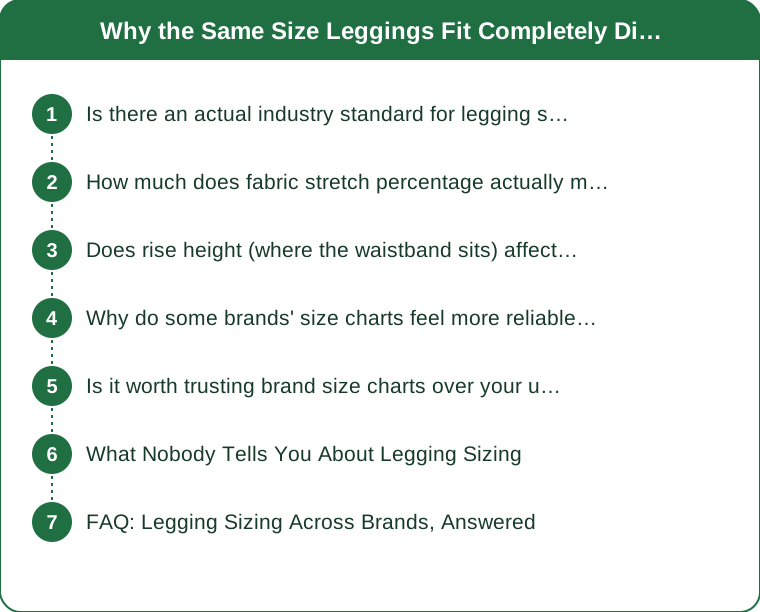
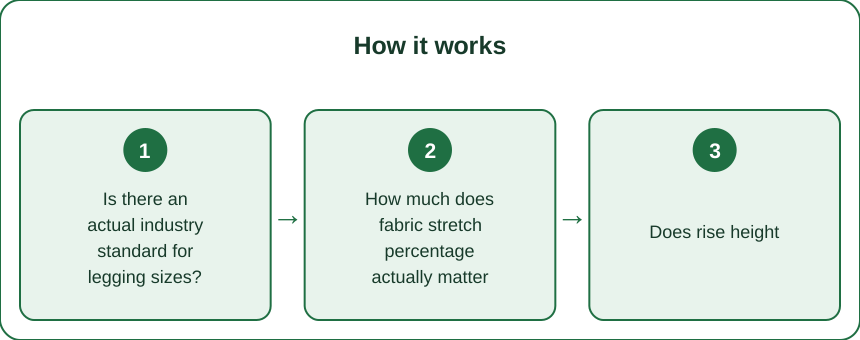
Is there an actual industry standard for legging sizes?
No — unlike some regulated industries, there’s no enforced universal sizing standard for activewear, so each brand sets its own size chart independently based on internal decisions. Each brand also designs around its own ‘fit model’ — a real or averaged body shape the sizing is built around — and fit models differ in proportions between brands, especially in waist-to-hip ratio and rise length, which shifts how a labeled size actually fits real bodies.
How much does fabric stretch percentage actually matter for fit?
A legging with 20% stretch fabric behaves very differently at the same labeled size than one with 40% stretch, since higher-stretch fabric is more forgiving across a range of body shapes while lower-stretch fabric requires closer-to-exact sizing. This is part of why a brand known for extremely stretchy fabric can get away with fewer size options while still fitting a wide range of people comfortably.
Does rise height (where the waistband sits) affect how sizing feels, separate from the size number?
Yes — a high-rise legging and a mid-rise legging in the ‘same’ size distribute fabric differently across the waist and hip, so the same size number can feel tight at the waist in one style and loose in another from the same brand. This is why checking rise height, not just size, matters when comparing across brands or even within one brand’s different product lines.
Why do some brands’ size charts feel more reliable than others over time?
Brands with more frequent fit model updates and broader size ranges tend to produce more consistent sizing feedback from customers, since they’re actively testing across more body types rather than relying on an older, narrower fit model. Checking recent reviews specifically mentioning fit accuracy is one of the more reliable ways to gauge this before buying a new brand.
Is it worth trusting brand size charts over your usual size number?
Yes — checking the specific brand’s size chart measurements (waist and hip in inches, not just S/M/L) against your own measurements is far more reliable than assuming your usual size number carries over. This takes an extra two minutes before ordering but prevents the most common source of legging fit disappointment.
What Nobody Tells You About Legging Sizing
Sizing inconsistency isn’t a flaw you’re supposed to fix by losing or gaining weight to ‘fit the size’ — it’s a structural feature of an unregulated industry, and treating your measurements as the constant while treating each brand’s chart as the variable removes a lot of unnecessary frustration. Many people who switch to measurement-based shopping instead of size-number shopping report far fewer fit disappointments within just a couple of orders.
FAQ: Legging Sizing Across Brands, Answered
Should you size up or down when trying an unfamiliar brand?
Neither by default — check the brand’s actual size chart in inches against your measurements rather than guessing up or down from your usual size.
Do petite or tall size options solve most of the fit inconsistency?
They solve length-related fit issues specifically, but waist-to-hip proportion differences between brands still require checking the size chart directly.
Is it worth buying the same size across a brand’s different legging styles?
Not necessarily — different rise heights and fabric blends within one brand’s own lineup can shift fit enough that checking each style’s specific chart is still worthwhile.
TL;DR:
- No industry-wide sizing standard exists for leggings, so each brand builds its own chart
- Fit models, fabric stretch percentage, and rise height all shift how a labeled size actually fits
- Measurement-based shopping (inches against a brand’s chart) beats trusting a size number
- Sizing inconsistency is a structural industry issue, not a sign anything is wrong with your body
Treat your own measurements as the fixed reference point and each brand’s chart as the variable — that mindset shift alone solves most of the fit surprises.
See It in Motion
Seen here: High Waist Yoga Leggings with Inner Pocket — shop it on bubblelime.com
Keep Reading
This article is for general informational and styling purposes only. Fit, sizing, and product availability may vary.