How Long Should a Pair of Leggings Actually Last?
Quick Answer: A well-made pair worn twice a week and washed correctly should give you roughly 18 to 30 months, or about 150 to 250 wear-and-wash cycles, before the elastane meaningfully degrades. Cheaper pairs land closer to 60 to 100 cycles. What kills them is almost never the workout. It is heat, oil and chlorine, in that order, which is why the dryer is the single largest variable in how long your leggings last.
One pair still looks new after two years. Another sagged at the knee in four months. Same price bracket, same brand, wildly different outcomes.
Most of the difference is not luck, and it is not the workouts. Here is what actually decides it, answered question by question.

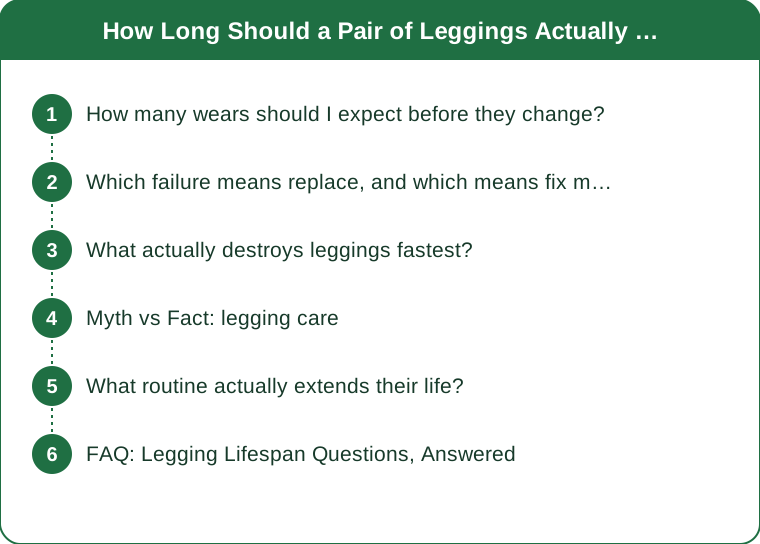
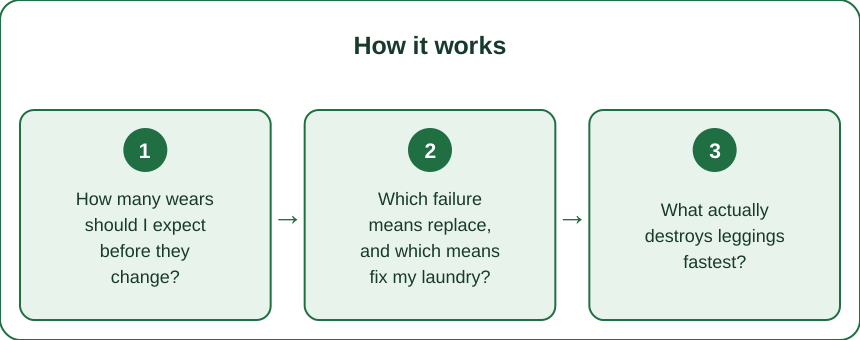
How many wears should I expect before they change?
Think in wash cycles rather than months, because that is what the fabric experiences.
Well-constructed leggings with 20 to 28 percent elastane in a dense knit: 150 to 250 wear-and-wash cycles before you notice reduced recovery. At twice a week, that is a year and a half to two and a half years.
Budget leggings with lower elastane content or a looser knit: 60 to 100 cycles, so roughly six to twelve months at the same usage.
Compression-focused pairs: often shorter, not longer. High compression relies on elastane working near its limit, and material fatigue accumulates faster there.
Does wearing them more often wear them faster?
Wearing itself is gentle. Washing is where the damage happens, so a pair worn twice before washing lasts meaningfully longer than a pair washed after every single wear, assuming the wear was not a sweaty one.
Which failure means replace, and which means fix my laundry?
This is the question that saves the most money, because half of what people call worn out is reversible.
Replace: loss of recovery, where the fabric no longer returns to shape and you get bagging at the knee or seat within an hour of wearing. This is elastane fatigue and it does not come back.
Replace: sheerness from thinning, where you can see the fabric structure has genuinely opened up rather than just stretched.
Fix your laundry: residual smell after washing. That is bacteria in a fabric that was washed too cool or with too much softener, not a dead garment.
Fix your habits: pilling on the inner thigh. That is friction abrasion, and while it is permanent on that pair, it tells you about fit and fabric choice for the next one.
Fix your storage: waistband roll. Often a fit issue or a stretched-out waistband from hanging by the band rather than folding.
How do I test recovery at home?
Pull a section of fabric to about 150 percent of its resting width, hold five seconds, release. It should snap back to almost exactly its original dimension. If it stays visibly wider, that pair is past its useful life.
What actually destroys leggings fastest?
In order of damage per exposure:
1. Heat. Elastane degrades with heat, and a hot dryer is the most concentrated heat exposure your leggings will ever face. A single hot dryer cycle can do more damage than a month of workouts. Hot washes matter too.
2. Oil. Body oils, lotions and sunscreen break down elastane over time and are not fully removed by a cold gentle wash. This is why sunscreen season is legging season in the worst way.
3. Chlorine. Devastating to elastane. A single afternoon in a chlorinated pool in non-swim leggings can cause visible damage.
4. Fabric softener. Coats fibres, reduces wicking, traps odour-causing bacteria, and provides no benefit to a synthetic knit.
5. Friction. Rough surfaces, velcro, and thigh-on-thigh abrasion. Real but slow compared to the first four.
Is the washing machine or the dryer worse?
The dryer, by a wide margin. If you change one habit, change that one.

Myth vs Fact: legging care
Myth: You must wash leggings after every wear. Fact: After a sweaty session, yes, and promptly. After a gentle wear, an airing is often enough, and the reduced wash count extends life measurably.
Myth: Hand washing is much better. Fact: A cold gentle machine cycle in a mesh bag is close enough for almost everyone, and the compliance rate is far higher.
Myth: Turning them inside out is fussy. Fact: It is one of the highest-value habits available. The inside faces your body oils and needs the cleaning, and the outside is protected from abrasion against the drum.
Myth: Expensive always lasts longer. Fact: Price correlates with construction quality but not perfectly. Knit density and elastane content predict lifespan better than price does, and both are usually printed on the label.
Myth: Sagging means you bought the wrong size. Fact: Sagging within the first few wears is a sizing or fabric issue. Sagging after a year is normal material fatigue.
What routine actually extends their life?
Nothing complicated, and it takes no extra time once it is habit:
-
Wash cold, on a gentle cycle, inside out, in a mesh bag. Cold water is the single biggest lever.
-
Air dry flat or on a rack. Never the dryer, and never hung by the waistband, which stretches it under the weight of wet fabric.
-
Skip fabric softener entirely. Use a small amount of a sport-specific detergent if odour is an issue.
-
Rinse immediately after chlorine or salt water, even if you cannot wash properly until later.
-
Apply sunscreen and let it absorb fully before dressing. Ten minutes is enough and it removes most of the oil transfer.
-
Rotate at least three pairs. Elastane recovers with rest, and a pair that gets 48 hours between wears holds its shape longer than a pair worn back to back.
Does rotating really make a difference?
Yes, and it is underrated. Elastane needs recovery time to return to its resting length. Rotation is the cheapest life extension available.
How should I store them?
Folded, not hung. Hanging puts constant tension on whichever part carries the weight.
FAQ: Legging Lifespan Questions, Answered
Is it worth repairing a legging seam?
For a seam split on an otherwise good pair, yes, a zigzag stitch or a professional repair costs little. For fabric that has lost recovery, no. You are repairing a garment that will fail elsewhere within weeks.
Do leggings shrink or stretch over time?
Both, in sequence. Early on they may relax slightly with wear and return with washing. Late in life they stretch and stop returning, which is the end signal.
Can I revive stretched-out leggings?
A cold wash and full air dry sometimes restores a little apparent recovery on a pair that was simply worn twice too long. Genuine elastane fatigue is permanent.
How many pairs do I actually need?
Three to five for someone training three or four times a week. Fewer means back-to-back wears with no recovery. More than five and you are storing rather than rotating.
What should I look for when buying a replacement?
Check the label for elastane percentage in the low-to-mid 20s, do the stretch-and-release test in the store, and check the inseam construction. Flatlock seams last longer than overlocked ones at the inner thigh.
TL;DR:
- Expect 150 to 250 wash cycles from a good pair, 60 to 100 from a budget pair.
- Heat, oil and chlorine cause almost all real damage. The dryer is the single worst offender.
- Loss of recovery means replace. Smell, pilling and roll usually mean change a habit.
- Wash cold and inside out, air dry, skip softener, and rotate at least three pairs.
The pair that lasted two years and the pair that died in four months probably had similar fabric. What differed was the laundry routine, and that is the part you fully control.
See It in Motion
Seen here: Super High Waist Embossed Yoga Leggings with Inner Pocket — shop it on bubblelime.com
Keep Reading
This article is for general informational and styling purposes only. Fit, sizing, and product availability may vary.