Leggings in Cool Weather: Every Question Answered
Quick Answer: For cool-weather training, wind resistance and moisture handling matter more than thickness. Fleece-lined leggings are excellent below about 40°F and too warm above it, and most people’s autumn discomfort comes from a damp fabric in wind rather than from insufficient insulation.
Every autumn the same questions arrive, and most of the advice answers them with thickness alone.
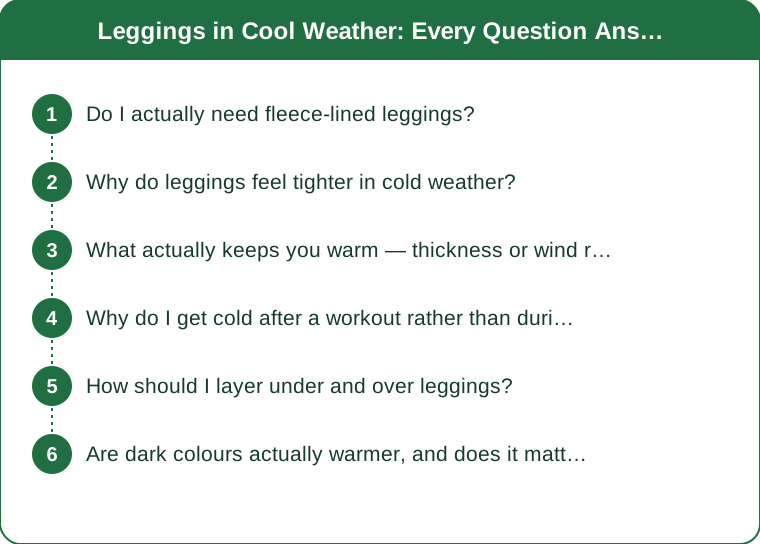
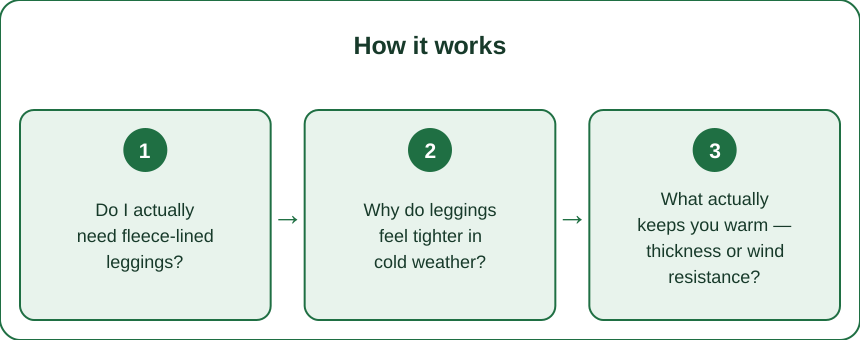
Thickness is one variable out of four, and it is rarely the one that decides whether you are comfortable. Here is the whole set, question by question.
Do I actually need fleece-lined leggings?
Only below a fairly specific temperature, and later than most people buy them.
Fleece lining adds real insulation, and insulation is only useful when your body is producing less heat than it is losing. During exercise you produce a great deal of heat, so the threshold at which fleece lining stops being too warm is lower than the threshold for standing around outdoors.
Rough guide for training outdoors: standard leggings are comfortable down to around 45 to 50°F for most people once moving. Fleece-lined leggings come into their own below roughly 40°F. Between those two, a standard legging plus a wind-resistant outer layer usually beats a fleece lining.
For walking, watching sport or generally being outdoors without producing much heat, shift both numbers up by ten degrees or so.
The most common mistake is buying fleece-lined for autumn and finding they are unusable by the second mile. Fleece lining is a winter purchase.
There is also a middle option people overlook: brushed-interior leggings, which have a lightly raised inner face rather than a full fleece. They add noticeably less warmth than fleece and cover much of the 40 to 50°F gap where standard leggings are marginal and fleece is too much.
Why do leggings feel tighter in cold weather?
Three things happening at once, and none of them is the leggings shrinking.
Elastane stiffens as temperature drops. Spandex and elastane fibres have a temperature-dependent modulus — they become less compliant when cold. The garment has the same dimensions and requires more force to stretch, which reads to you as tighter.
Your body changes slightly. Cold causes peripheral vasoconstriction and mild muscle stiffness, and you move differently, which changes how the fabric sits.
You are wearing more underneath. Even a thin base layer changes the fit noticeably in a compression garment.
The practical implication: do not size up for winter based on how leggings feel in the first cold five minutes. They loosen measurably once you are warm and the fabric has come up to body temperature, and a pair sized for cold-and-static will be loose and unsupportive once you are moving.
What actually keeps you warm — thickness or wind resistance?
Wind resistance, for most autumn conditions, by a considerable margin.
Still air is a good insulator, and the thin layer of warm air trapped against your skin does most of the work. Wind strips that layer away continuously, which is why 45°F with a 15 mph wind feels dramatically colder than 45°F still.
A thin wind-resistant panel on the front of the thigh does more than a substantially thicker legging with no wind resistance, because the front of the thigh takes the wind directly during running, cycling and walking into a breeze.
This is why the better cold-weather leggings use panelled construction — wind-resistant fabric on the front, breathable stretch fabric behind the knee and at the back. It is more expensive to manufacture and it works considerably better than uniform thickness.
If your current leggings are uncomfortable in autumn wind and you are choosing what to replace them with, prioritise a wind-resistant front panel over grams of fabric.
You can test this on a garment you already own. Hold the fabric up and blow through it firmly — if you feel your breath easily on the other side, it offers essentially no wind protection regardless of how substantial it feels in the hand.

Why do I get cold after a workout rather than during?
Because you are damp, you have stopped generating heat, and the fabric is now working against you.
During exercise, evaporation from a moist fabric is helpful — it removes heat you are producing in excess. The moment you stop, that same evaporation continues while your heat production drops by 80 percent or more. Wet fabric conducts heat away roughly 25 times faster than dry fabric, and the chill arrives within a few minutes.
This is the single most common autumn discomfort and it has nothing to do with how warm the leggings are during the session.
The fixes, in order of effectiveness: change out of damp leggings before standing around; choose fabrics that move moisture rather than holding it, which generally means synthetic or merino rather than cotton-blend; and add a layer immediately on finishing rather than once you feel cold.
Cotton-blend leggings are the specific problem item. They feel lovely and they hold moisture, which makes them a poor choice for anything that involves sweating in cool air.
How should I layer under and over leggings?
Thin and smooth underneath, wind-resistant over the top, and nothing bulky in between.
Underneath, below about 35°F: thin merino or synthetic tights. The key word is thin — a bulky base layer under a compressive legging is uncomfortable and restricts movement, and it compresses the air layers that were doing the insulating anyway.
Over the top, for the coldest conditions or high wind: wind-resistant running trousers or a thin shell. Two thin layers with air between them outperform one thick layer of the same total weight.
What not to do: double up on standard leggings. It sounds sensible and produces compression without insulation, restricting circulation to your legs at the moment you least want that.
The transitional-weather answer — which is what most of autumn is — is a single good legging plus a layer you can add and remove for the first and last ten minutes. Those bookends are where the discomfort lives; the middle of the session is almost always fine.
Are dark colours actually warmer, and does it matter?
Marginally warmer in direct sun, irrelevant otherwise, and mostly the wrong thing to optimise.
Dark fabric absorbs more solar radiation, and on a bright cold day in direct sun that is a real if modest effect. In shade, in cloud, or after dark it makes no difference at all.
What matters far more in autumn is visibility. Daylight hours shorten quickly, morning and evening sessions move into low light, and dark leggings in low light are genuinely difficult for drivers to see.
If you train outdoors in autumn, reflective detail on the lower leg is worth more than any thermal property, because the lower leg is moving and moving reflectors are what actually catch a driver’s attention.
Practical answer: choose colour for visibility and preference, choose fabric for wind and moisture, and do not let the warmth argument drive the decision.
TL;DR:
- Fleece lining is a winter purchase, not an autumn one — below roughly 40°F for active use.
- Cold-stiffened elastane makes leggings feel tighter than they are; do not size up based on the first cold five minutes.
- Wind resistance beats thickness for most autumn conditions, and a wind-resistant front panel is the feature worth paying for.
- The post-workout chill is a damp-fabric problem — change or layer immediately rather than buying warmer leggings.
Before buying anything this season, note which part of your session is actually uncomfortable. If it is the first and last ten minutes, you need a layer, not new leggings.
See It in Motion
Seen here: High Waist Embossed Yoga Leggings with Side Pockets — shop it on bubblelime.com
Keep Reading
This article is for general informational and styling purposes only. Fit, sizing, and product availability may vary.