Leggings Waistband Problems: Every Question Answered
Quick Answer: Waistband failures come from a mismatch between the band and your body’s shape, not your size. Rolling means the band is being compressed by a curve above or below it. Digging means the band is narrower or stiffer than your waist-to-hip difference needs. Sliding down means insufficient hip grip. Gaping at the back means a waist-to-hip ratio the pattern did not anticipate. Each has a specific fix below.
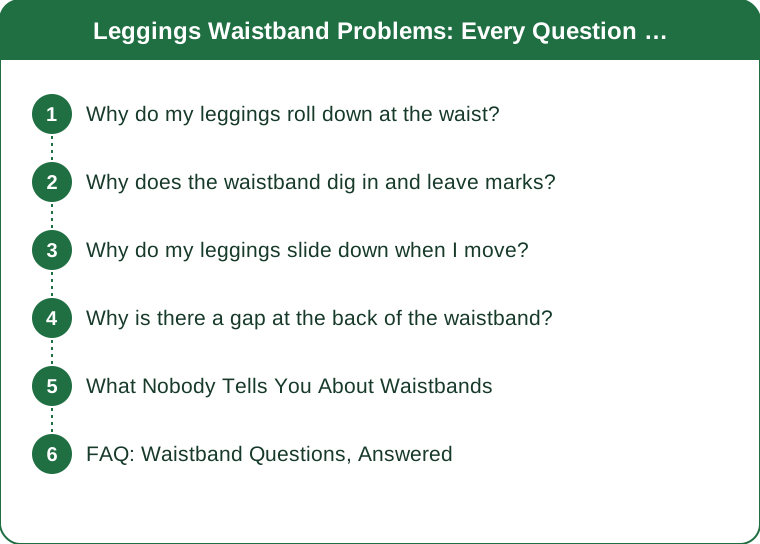
Every question people actually ask about waistbands, answered in order.

Why do my leggings roll down at the waist?
Because the band is being squeezed from above or below and takes the path of least resistance.
The most common cause is a soft roll above the band. When tissue sits over the top edge, it presses down and folds the band outward. This is normal anatomy, not a sizing failure, and it affects a very large proportion of people.
A band that is too narrow amplifies it. Narrow bands have less surface area to distribute pressure and fold far more easily. A band of 10 to 15 centimetres holds where a 5-centimetre one does not.
Sizing down makes it worse, not better. Tighter fabric increases the compression that causes the fold in the first place. This is the most common wrong response.
A too-low rise causes it too. If the band sits at the widest part of your abdomen rather than at your natural waist, it will migrate. High-rise bands that sit at or above the narrowest point stay put.
Fabric weight matters. Thin, light fabrics roll far more readily than substantial ones with real recovery. This is where cheap leggings fail first.
The fixes: go wider and higher on the band, keep or increase your usual size, choose a thicker fabric with a high spandex content, and look for a band with an internal drawcord or a bonded rather than elasticated edge.
Why does the waistband dig in and leave marks?
Because pressure is concentrated over too small an area.
Narrow bands concentrate force. The same tension across a 4-centimetre band creates far more pressure per square centimetre than across a 15-centimetre one. Wide bands feel looser at the same actual compression.
Elastic inserts create a hard edge. Bands with a separate elastic strip sewn inside produce a distinct pressure line. Fully bonded or fabric-integrated bands distribute more evenly.
A large waist-to-hip difference concentrates the load. If your hips are much larger than your waist, the band has to stretch over the hips and then sits on a much smaller circumference, ending up tighter than intended.
Seams at the band edge are the usual culprit for marks. A visible line after a two-hour wear is usually a seam, not the compression itself.
Mild temporary marks are normal. Any snug garment leaves an impression. Marks that remain for a long time, cause numbness, or come with tingling mean the band is genuinely too tight.
The fixes: wide bonded bands, seamless construction, sizing up while keeping the leg fit through a smaller leg opening, and avoiding compression-specific styles for all-day wear.
Why do my leggings slide down when I move?
Because nothing is gripping, and gravity plus movement wins.
Grip comes from the hip, not the waist. A band that only holds at the waist has to fight gravity alone. A pair that fits closely across the hips and upper thigh is held in place by the whole garment.
Worn-out elastane is a common cause. After enough washes and wears, recovery declines and the band no longer returns to size. If a pair used to stay up and no longer does, this is why.
Fabric with too little spandex slides. Below about 15 percent elastane, most leggings lack the recovery to stay put through squats and lunges.
A slippery finish reduces grip. Very smooth, buttery fabrics feel lovely and grip skin less than slightly textured ones.
Sizing up to solve digging causes sliding. This is the trade-off people fall into. The answer is a wider band at the same size, not a bigger size.
The fixes: look for silicone grip strips inside the band, an internal drawcord, higher elastane content, and a snug fit through the hip rather than a tighter waist. Washing cold and air drying meaningfully extends elastane life.

Why is there a gap at the back of the waistband?
Because the pattern assumed a different waist-to-hip relationship than yours.
Most leggings are cut for an average ratio. A smaller waist relative to the hips means the band, sized to fit your hips comfortably, is too large at the waist and gaps at the back.
Rise length is often the real issue. A back rise that is too short pulls the band forward and down when you bend or sit, creating a gap that was not there standing still.
A curved or contoured band solves it. Bands cut with a higher back and a shaped seam follow the body’s curve. Straight-cut bands cannot.
Drawcords help but do not fix the cut. Cinching a straight band creates bunching at the front while the back still gaps.
Squat-test standing and seated. Many gaps only appear when sitting, which is where most people spend the day.
The fixes: contoured or V-shaped back bands, styles with a longer back rise, and brands that offer curve-specific or petite-and-tall variations. If one brand always gaps on you, the pattern block is the issue and no size will fix it.
What Nobody Tells You About Waistbands
Wider almost always beats tighter. The instinct to size down is the single most common mistake and it makes three of the four problems worse.
The band is the first part to fail. Elastane degrades fastest where it is stretched most and washed hottest. A pair can have perfectly good legs and a dead waistband.
Heat is what kills them. Hot washes, tumble drying and being left in a hot car all accelerate elastane breakdown. Cold wash and air dry roughly doubles usable life.
Fabric softener destroys grip. It coats the fibres, reduces elasticity and makes silicone grip strips stop working. Skip it entirely on activewear.
Pocketed bands change the mechanics. A phone in a side band pocket adds weight in one spot and drags that side down. Fine for a walk, poor for running.
The same size differs by 5 centimetres between brands. There is no meaningful standardisation. Your size is a starting guess, not information.
Try them by squatting in the changing room. Standing still tells you almost nothing about how a waistband will behave.
FAQ: Waistband Questions, Answered
Should I size up or down for rolling?
Neither, usually. Change the band width and rise height at your normal size.
How wide should a waistband be?
Ten to fifteen centimetres suits most people for all-day and training wear. Below about seven centimetres, rolling becomes much more likely.
Do drawcords actually help?
Yes for sliding, partially for gaping, and not at all for rolling caused by compression above the band.
How long should a good pair last?
With cold washing and air drying, roughly one to two years of regular wear before the band loses meaningful recovery.
Is a rolled band harmful?
Uncomfortable rather than harmful, though a rolled band concentrates pressure into a narrow ridge, which is why it can feel worse than the flat version.
TL;DR:
- Rolling means the band is too narrow or too low. Go wider and higher, not smaller.
- Digging means pressure over too small an area. Wide bonded bands fix it.
- Sliding means no hip grip. Look for grip strips, higher elastane, a snug hip fit.
- Gaping is a pattern-shape mismatch. Contoured back bands and longer back rises solve it.
- Cold wash, air dry, no fabric softener — heat and softener are what kill waistbands.
Size down is almost never the answer. Wider band, same size.
See It in Motion
Seen here: High Waist Embossed Yoga Leggings with Side Pockets — shop it on bubblelime.com
Keep Reading
This article is for general informational and styling purposes only. Fit, sizing, and product availability may vary.