Leggings That Still Smell After Washing: Every Question, Answered
Quick Answer: Polyester and nylon are oil-loving fibers, and body oils carrying odor compounds bind inside them where water-based detergent cannot reach. The odor survives washing and returns when the fabric warms up. Fixing it takes a pre-soak in a vinegar or enzyme solution, a cold wash with less detergent, and air drying — plus never leaving damp leggings balled up.
They came out of the wash smelling like nothing. Ten minutes into your warm-up, the smell is back.
That is a specific and well-understood phenomenon, and every part of it has a fix.

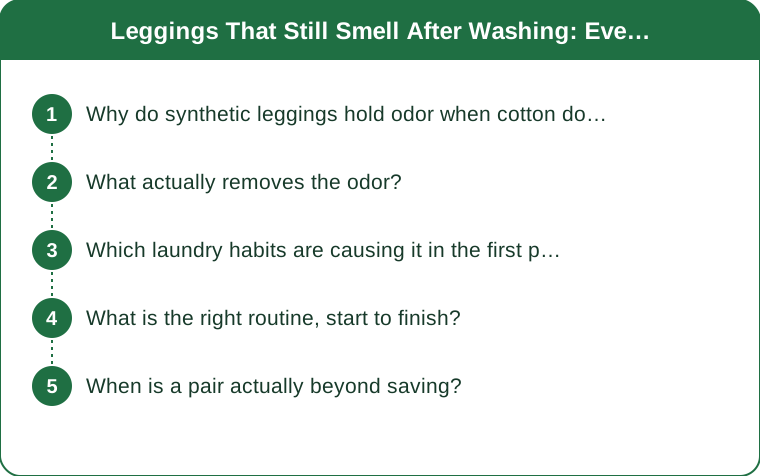
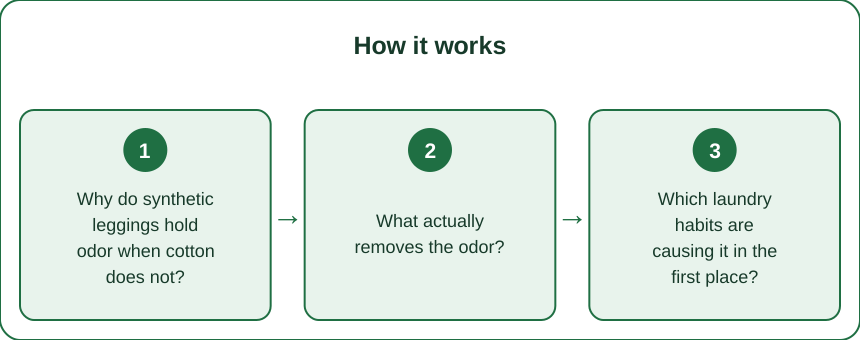
Why do synthetic leggings hold odor when cotton does not?
Because the fibers have opposite relationships with oil.
Polyester and nylon are oleophilic — they attract and hold oils. The odor compounds from your skin and from bacterial breakdown are largely oil-soluble. They migrate into the fiber itself, not just onto the surface.
Detergent is water-based and works on the surface. A standard wash cycle lifts water-soluble soil efficiently. The oils bound inside a synthetic fiber are mostly untouched, which is why the garment can be genuinely clean by every other measure and still smell.
Cotton is hydrophilic. It absorbs water and sweat rather than oil, and a normal wash flushes it out. Cotton develops odor while damp and loses it in the wash. Synthetics do the reverse.
Heat reactivates it. The compounds are volatile — they evaporate faster when warm. That is why the smell is absent from a cool folded garment and present within minutes of your body heat, and why it seems to appear from nowhere.
Does this mean synthetic leggings are a bad choice?
No. The same properties that hold odor also give you stretch, recovery, moisture movement, and durability that cotton cannot match. The trade-off is a laundry protocol, which is a much smaller cost than the alternative.
What actually removes the odor?
Something that targets oil, and time.
Does a vinegar soak really work?
Yes, and it is the cheapest option. One cup of white vinegar in a basin of cool water, leggings fully submerged, 30 minutes to an hour. The acidity helps break the bond between the residues and the fiber. Then wash normally. Do not add vinegar and detergent at the same time — they partially cancel each other.
What about enzyme cleaners or sport detergents?
These are the more thorough option. Enzyme-based sport washes are formulated specifically to break down body oils and proteins in synthetics. A pre-soak of a few hours in a diluted enzyme solution handles cases that vinegar alone will not. If your leggings are badly set in, this is the route.
Does baking soda help?
Somewhat, for freshening, and much less for set-in odor. It is alkaline and works on different residues than vinegar does. Useful in a rotation, not a solution by itself. Never combine it with vinegar in the same soak — they neutralize each other and you get salt water.
How long does it take?
One good soak fixes most cases. Deeply set odor from months of habit sometimes needs two or three cycles across separate washes. If two full enzyme soaks have not touched it, the fiber has probably taken as much as it will give back.

Which laundry habits are causing it in the first place?
Five, and most people are doing at least three.
Am I using too much detergent?
Almost certainly. Excess detergent does not rinse out of tight synthetic knits — it builds up as a film that traps oils and bacteria, making the problem worse with every wash. Use roughly half the recommended amount for activewear. This is the most common cause and the easiest fix.
Does fabric softener matter?
It is the single worst thing you can put on activewear. Softener works by coating fibers in a waxy layer, which destroys moisture-wicking and traps odor permanently. Dryer sheets do the same. Skip both entirely, forever.
How bad is leaving them in the gym bag?
Bad, and it is where most permanent odor comes from. Damp synthetic fabric in a sealed bag at body temperature is an ideal bacterial environment, and a few hours produces more odor buildup than the workout did. If you cannot wash them same-day, at least hang them to dry.
Hot or cold water?
Cold. Hot water sets protein-based residues and damages elastane, which shortens the garment’s life. Cold plus a proper pre-soak beats hot every time for this specific problem.
Does the dryer make it worse?
Yes, twice over. Dryer heat bakes any remaining oils into the fiber, making them much harder to remove later, and it degrades elastane so the leggings lose shape faster. Air dry, always.
What is the right routine, start to finish?
A protocol you can run without thinking about it.
Immediately after the workout: hang them, do not bag them. Anywhere with air. A hook on the back of a door is enough.
Before washing: turn them inside out. The side with your body oils is the side that needs contact with the water.
Weekly or when needed: a 30-minute cool soak in vinegar or a diluted enzyme wash before the cycle.
In the machine: cold water, gentle cycle, half the usual detergent, no softener. A mesh bag protects the waistband and prevents snagging against zippers.
After: air dry, ideally not in direct sun, which degrades elastane over time.
Does washing after every wear matter?
For anything you sweated in, yes. The idea that you can get two wears out of leggings applies to a low-intensity day at most. Odor compounds accumulate, and each unwashed wear makes the next wash less effective.
What about antimicrobial or silver-treated fabrics?
They genuinely delay odor development, and the effect diminishes over the life of the garment as the treatment washes out. Useful, not permanent, and not a substitute for the routine above.
When is a pair actually beyond saving?
There is a real end point, and recognizing it saves you effort.
How do I know it is permanent?
If two thorough enzyme soaks in separate washes have not reduced it, the oils have bound deeply enough that domestic laundry will not reverse it. This is often called permastink, and it is a genuine end state rather than a technique failure.
What causes it to get to that point?
Usually a combination: months of fabric softener, consistently too much detergent, hot washes, dryer heat, and time spent damp in a bag. Any one of those alone rarely does it. All five together reliably do.
Can I still use them?
For low-sweat use — lounging, errands, walking — often yes, since the odor is heat-activated and mild activity may not trigger it. For training, they will smell within minutes every time.
What should I do differently with the next pair?
Start the routine on day one rather than after the problem appears. New leggings that are never softened, never over-detergented, never dried hot, and never left damp in a bag can stay odor-free for years. The protocol is preventive far more than it is curative — that is the real lesson here.
General care information — always check the garment’s own care label, since some technical fabrics have specific requirements.
TL;DR:
- Synthetic fibers hold oil-based odor compounds inside the fiber, where water-based detergent cannot reach
- Fix it with a cool vinegar or enzyme pre-soak, then cold wash with half the usual detergent
- Never use fabric softener or dryer sheets, never machine dry, and never leave damp leggings in a bag
- Two failed enzyme soaks means it is permanent — but starting the routine on a new pair prevents it entirely
This is one of the rare laundry problems where doing less works better. Less detergent, less heat, less time in the bag — and the pair you already own probably comes back.
See It in Motion
Seen here: Super High Waist Embossed Yoga Leggings with Inner Pocket — shop it on bubblelime.com
Keep Reading
This article is for general informational and styling purposes only. Fit, sizing, and product availability may vary.