Why Your Leggings Waistband Keeps Rolling Down (and the Actual Fix)
Quick Answer: A rolling waistband has two causes: the elastane has broken down from wear and washing, or the fit doesn’t match your body. The real fixes are sizing down to test snugness, switching to a wide structured or double-layer waistband, and choosing leggings with 18%+ elastane. Tugging mid-workout and wearing a longer top are workarounds, not solutions.
Fourth squat of the set, and the waistband has folded over itself again.
You yank it up. Rep five. Yank. Rep eight. Yank.
Forty tugs a session, every session, and the actual cause is one of exactly two things — both of which are fixable, and neither of which is tugging harder.

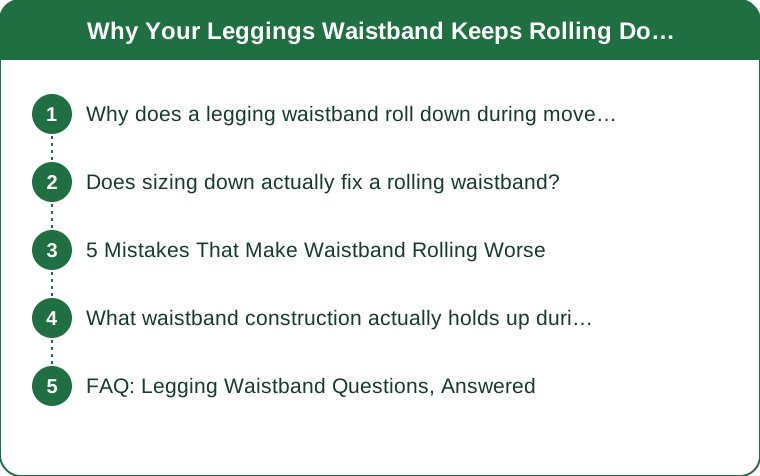
Is It the Fabric or the Fit?
Almost always one of these two. Diagnose before you fix.
It’s the fabric if: the leggings used to stay put and now don’t. Something that changed over time is a material story.
It’s the fit if: they’ve rolled since the first wear. Something that was always true is a sizing or construction story.
Quick self-test: stretch the waistband out to twice its width and let go. Does it snap back crisply, or return slowly and slightly loose? Crisp snap-back means the elastane is intact and you have a fit problem. Sluggish return means the elastane is done.
That single test tells you which of the next two sections applies to you.
Why Does Legging Fabric Stop Holding Its Shape?
Three material factors, in order of how often they’re the culprit.
1. Low elastane percentage. Elastane (also sold as spandex or Lycra) is what gives a legging its recovery — the ability to stretch and return. A blend with only 8–12% elastane stretches out during movement and doesn’t fully return within the session, so the waistband loses its grip and rolls.
The threshold worth knowing: 18% and above for leggings you intend to squat in. Below 15%, rolling is likely regardless of fit.
2. Elastane breakdown from wear and washing. Elastane fibers degrade over time, and three things accelerate it dramatically: heat, chlorine, and fabric softener. A hot wash or a tumble dryer cycle does more damage in one pass than a month of wearing them.
If your leggings used to stay put and now roll consistently, the internal elastic has broken down. That’s a garment nearing the end of its useful life, not a fluke — most leggings worn twice weekly last about 12–18 months before recovery noticeably declines.
3. Fabric weight. Thinner, lighter fabrics have less structural resistance to folding. A 180 gsm legging rolls more readily than a 280 gsm compressive one, all else being equal. Lightweight fabrics are marketed as buttery and breathable, which is true — and they trade away some rolling resistance to get there.
Why Does the Fit Cause Rolling?
Three fit factors, all independent of fabric quality.
1. The waistband is too loose. A waistband sized slightly large has nothing to grip against. It sits on the body rather than holding it, so any movement folds it over. This is the most common cause in leggings that rolled from day one.
Note that this is separate from overall size — you can need a size 10 in the leg and a snugger waistband, which is exactly why the size-down test is worth running.
2. Rise doesn’t match your torso length. If a legging’s rise is designed for a longer torso than yours, the waistband sits above your natural waist, on the narrowing part of the ribcage — and it will slide down to the widest point it can find. If the rise is too short, it sits below your natural waist on the hip flare and folds every time you hinge.
The waistband wants to sit at the smallest circumference of your torso. Wherever it’s forced to sit instead, movement will relocate it.
3. The waistband style is wrong for you. Fold-over waistbands, thin elastic bands, and unstructured single-layer bands are all inherently more roll-prone than a wide, seamed, double-layer construction. This is a construction property, not a sizing one — even a perfectly-sized fold-over band can roll.

What Actually Fixes a Rolling Waistband?
Three real solutions, matched to the three causes.
1. The size-down test. Try a size down in the same style. You’re specifically testing whether waistband snugness resolves it — not whether the overall garment fits better. If the smaller size holds and the leg is uncomfortably tight, that tells you the brand’s waistband is under-sized relative to its leg, and you need a different brand rather than a different size.
2. Switch to a structured waistband. Look for leggings explicitly marketed with a wide, double-layer, or seamed waistband — typically 4 inches or more, often with an internal drawcord. These resist rolling by construction rather than by tension, which means they keep working as the fabric ages. A high waist legging with a wide structured band is the single most reliable fix for chronic rollers.
3. Prioritize elastane content on the next purchase. If rolling has happened across multiple pairs, filter by composition. 18% elastane or higher. It’s usually listed in the product details even when the fabric weight isn’t.
And wash them properly to protect what you have: cold water, no fabric softener (it coats and degrades elastane), and air dry always. The dryer is the single biggest killer of legging recovery, and skipping it can add six months to a pair’s usable life.
The 5 Mistakes Everyone Makes With Rolling Waistbands
- Tugging mid-workout. Treats the symptom for ninety seconds. Forty times a session.
- Wearing a longer top to hide it. Hides the problem visually while the mechanical issue continues — and you’re still adjusting, just less visibly.
- Sizing up for comfort. The instinctive response and exactly backwards. A larger waistband has less to grip and will roll more.
- Blaming your body. Rolling is a garment construction and fit-matching problem. A well-designed structured waistband stays put across an enormous range of body shapes.
- Tumble drying leggings. This is the one nearly everyone does, and it destroys elastane faster than anything else you can do to a legging. Air drying is free and roughly doubles the roll-free lifespan.
Frequently Asked Questions
How do I stop my leggings from rolling down?
Address the cause rather than the symptom: size down if the waistband is loose, switch to a wide structured or double-layer waistband if the style is unstructured, and replace the pair if the elastane has broken down. The stretch-and-release test tells you which applies.
What percentage of spandex should leggings have?
Look for 18% or higher for leggings you’ll squat, lunge, or run in. Blends in the 8–12% range stretch out during movement without fully recovering, which is a common source of both rolling waistbands and sagging knees. Higher elastane also tends to mean better squat-proofing.
Why do my leggings roll down when I squat?
Squatting flexes the hip fully, which pushes the waistband upward while the fabric stretches — if the band isn’t snug enough or is unstructured, it folds over rather than staying put. A wide seamed waistband handles this far better than a fold-over or thin elastic band.
Do high-waisted leggings roll down more?
Not inherently — a well-constructed high-rise band with proper width usually stays put better than a mid-rise one, because it sits at the natural waist. High-rise leggings roll when the rise doesn’t match your torso length or when the band is a thin, unstructured one that happens to sit high.
TL;DR:
- Two causes only: elastane breakdown (used to stay put, now doesn’t) or fit mismatch (rolled from day one).
- Test it: stretch the band and release. Crisp snap-back = fit problem. Sluggish return = elastane is done.
- Real fixes: size down in the same style, switch to a wide double-layer seamed waistband, buy 18%+ elastane.
- Sizing up makes it worse. A looser band has less to grip.
- Cold wash, no fabric softener, air dry always. The tumble dryer is what kills elastane fastest.
See It in Motion
Seen here: High Waist Embossed Yoga Leggings with Side Pockets — shop it on bubblelime.com
Keep Reading
This article is for general informational and styling purposes only. Fit, sizing, and product availability may vary.